Nobel Laureates in Crystallography
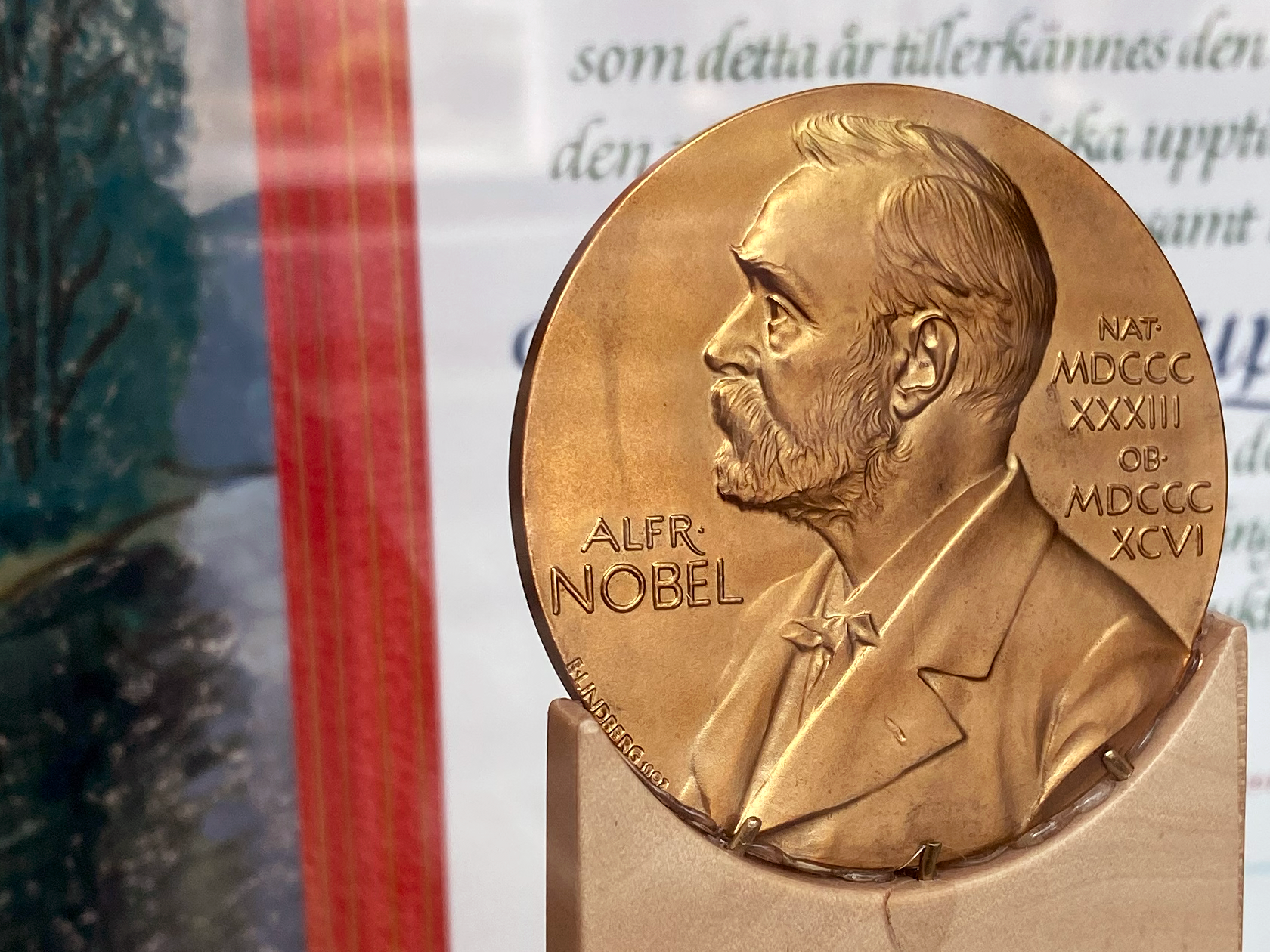 Crystallography has played a pivotal role in some of the most groundbreaking scientific discoveries of the last century—many of which have been honored with the Nobel Prize. This section highlights the laureates whose work advanced our understanding of crystal structures, diffraction methods, and the fundamental nature of matter. Their achievements span physics, chemistry, and medicine, reflecting crystallography’s wide-reaching impact across the sciences. Crystallography has played a pivotal role in some of the most groundbreaking scientific discoveries of the last century—many of which have been honored with the Nobel Prize. This section highlights the laureates whose work advanced our understanding of crystal structures, diffraction methods, and the fundamental nature of matter. Their achievements span physics, chemistry, and medicine, reflecting crystallography’s wide-reaching impact across the sciences.
Here you will find brief profiles of Nobel-recognized contributions, along with curated resources for exploring the broader history of the Nobel Prize. Whether you are learning about the pioneers who shaped the field or seeking deeper insight into the Nobel tradition, these materials provide a gateway to the scientific milestones that continue to inspire our community.
Why This History Matters
The sequence of Nobel Prizes shows an evolution: from discovering X-rays and basic diffraction, through mapping atomic structures of molecules and proteins, to understanding complex biological machinery — and now to predictive computational structure design.
Recent awards highlight that structural biology is not static: modern advances combine crystallography with computation and AI.
This continuum underscores the core role of structural methods (diffraction, modeling, computation) in understanding matter — from atoms to cells to machines.
Modern Era: Computational Structure Prediction & AI-Driven Structural Science
This milestone marks a new chapter: structural science moving beyond “just crystallography” into computational design and AI-enabled prediction, broadening the impact of structural insight across biology, medicine, and materials.
| 2024 |
David Baker; Demis Hassabis & John Jumper |
Awarded the Nobel Prize in Chemistry for computational protein design (Baker) and for methods to predict protein structures (Hassabis & Jumper). Their work dramatically accelerates structural biology, making it possible to determine or design protein structures far more rapidly than with traditional crystallography. |
From Molecules to Membranes & Complex Assemblies
| 1962 |
Francis Crick, James Watson & Maurice Wilkins |
Proposed the double-helix model of DNA, uncovering the structural basis for biological information storage. |
| 1988 |
Johann Deisenhofer, Robert Huber & Hartmut Michel |
Determined the first high-resolution membrane protein structure essential to photosynthesis. |
| 1994 |
Clifford Shull & Bertram Brockhouse |
Pioneered electron diffraction and neutron diffraction methods — broadening the structural toolkit beyond X-rays. |
| 2003 |
Peter Agre & Roderick MacKinnon |
Elucidated the structure of membrane channels, revealing how molecules move across cell membranes. |
| 2006 |
Roger Kornberg |
Revealed the molecular basis of eukaryotic transcription — key for understanding how genetic information is read and regulated. |
| 2009 |
Venki Ramakrishnan, Tom Steitz & Ada Yonath |
Determined the structure and function of the ribosome, a central molecular machine in all living cells.
|
| 2011 |
Dan Shechtman |
Discovery of quasicrystals, expanding crystallography’s reach into novel solid-state matter. |
| 2013 |
Martin Karplus, Michael Levitt & Arieh Warshel |
Developed multiscale models for complex chemical processes — bridging structural information and dynamic chemical behavior. |
| 2016 |
Jean-Pierre Sauvage, J. Fraser Stoddart & Ben Feringa |
Design and synthesis of molecular machines — showing how structural insight enables molecular engineering. |
| 2017 |
Jacques Dubochet, Joachim Frank, and Richard Henderson |
Advanced the technique of cryo-electron microscopy to determine biomolecule structures |
Expanding Structural Chemistry & Early Biological Structures
| 1954 |
Linus Pauling |
Determined the α-helical structure of proteins; made foundational advances in understanding chemical bonding.
|
|
1962
|
John Kendrew & Max Perutz
|
Solved structures of globular proteins (myoglobin, hemoglobin) — foundational work in protein crystallography and molecular biology.
|
|
1964
|
Dorothy Crowfoot Hodgkin
|
Solved important biochemical structures including cholesterol, penicillin, vitamin B₁₂, and insulin.
|
|
1976
|
William Lipscomb
|
Structural studies of boranes, shedding light on chemical bonding in unusual molecules.
|
|
1985
|
Herbert Hauptman & Jerome Karle
|
Developed direct mathematical methods for solving crystal structures — a major advance in crystallographic methodology.
|
Early Foundations
Additional Important Contributors (Non-laureates but Foundational)
Additional Resources
|
|
For those interested in exploring the full history of the Nobel Prizes—including detailed biographies, award citations, and archival materials—additional information is available directly on the official Nobel Prize website. It offers comprehensive resources on every prize, laureate, and scientific achievement recognized since the awards were established.
|
|
|
For a deeper look at the Nobel Prizes awarded for breakthroughs in crystallography, including laureate profiles and landmark scientific contributions, additional information is available through the IUCr. This resource offers an excellent overview of the field’s Nobel-recognized achievements.
|
|
|
The American Institute of Physics offers an excellent resource that highlights the scientific accomplishments of Nobel Prize winners across the physical sciences. This collection provides historical context, biographical information, and insightful commentary on the discoveries that shaped modern science. It’s a valuable companion for anyone interested in exploring the broader impact of Nobel-recognized research.
|
|
